


Teuffel Electric Guitars — Each Guitar Is a Message
Ulrich Teuffel was born in Kitzingen, Germany in 1965, trained as an automotive mechanic, built his first guitar at fourteen inspired by a photograph of a Steve Klein instrument in a design book, and spent the early 1990s studying industrial design and art history at university, where he spent most of his time building guitars in his room instead of attending lectures. That combination of mechanical precision, design education, and a refusal to do things the conventional way produced one of the most singular bodies of work in the history of the electric guitar.
He has been building from his live-work space in Neu-Ulm, Germany since 1988, entirely alone, producing approximately twenty-five instruments per year in a price range of $7,000 to $15,000. He designs and machines everything himself, from the bodies and pickups to the proprietary locking nut hardware and the individual stainless steel screws that hold his instruments together. Premier Guitar described him as a relentless and incorrigible tinkerer. The Boutique Guitar Showcase placed him on a plane that few contemporary guitar makers can aspire to. In the eyes of serious players and collectors worldwide, Teuffel's work is simply its own category.
His instruments have been played and collected by Billy Gibbons of ZZ Top, Kirk Hammett of Metallica, David Torn, Henry Kaiser, composer Ludwig Göransson, and film score legend Hans Zimmer. These are not casual celebrity endorsements. These are musicians and artists who have found in a Teuffel guitar something they cannot find anywhere else, and have held onto it accordingly.
The Philosophy
Teuffel describes each guitar as a message, a reflection of courage, doubt, and the desire to create something truly personal. He came to guitar making frustrated by what he saw as the technological stagnation of the electric guitar, an instrument that had relied almost entirely on the archetypal Fender and Gibson designs for decades without serious rethinking. He has spent nearly forty years doing that rethinking, and the results are instruments that the guitar world is still catching up to.
He considers his body of work an oeuvre to be completed once, a sequence of periods and ideas that build on each other and move in a single direction. He has left the conventional guitar behind entirely, discarded all remaining bodies and necks from his earlier models, and has no intention of turning back.
The Models
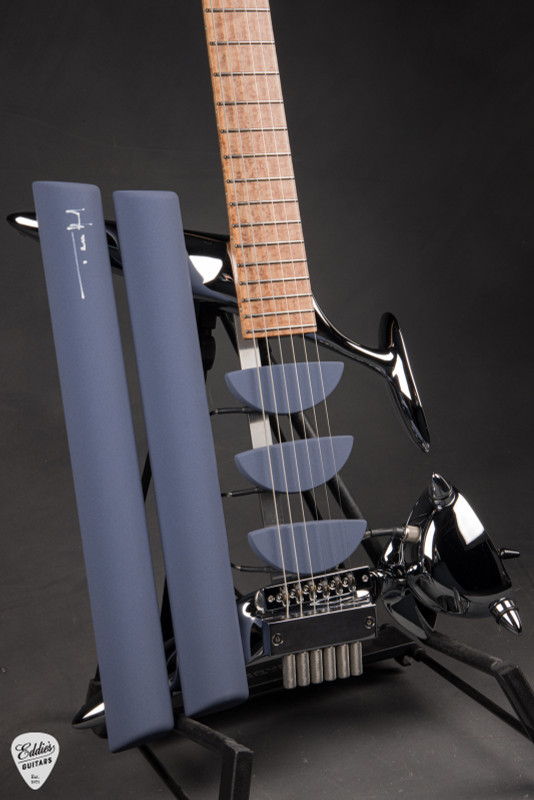
Birdfish — The instrument that announced Teuffel to the world at Frankfurt MusikMesse in 1995 and remains the most widely recognized model in the catalog. The Birdfish is built around an aluminum chassis with interchangeable tone bars in wood or aluminum that allow the player to alter the acoustic character of the instrument without changing the electronics or hardware. The moveable Alnico pickups can be repositioned along the chassis, varying the magnetic source of tone generation across a wide tonal range that no fixed-pickup instrument can approach. Inspired by Leo Fender's Stratocaster in its commitment to tonal versatility above all, the Birdfish is simultaneously a working musician's instrument and one of the most audacious pieces of design in the history of the electric guitar. The Rhodium Prodigy Birdfish, produced in only five examples, is among the most collectible instruments ever made.
Tesla — A headless teardrop-shaped instrument originally conceived as a seven-string model before a six-string version was added at player request, the Tesla features three custom pickups with individual noise controls, aircraft-grade aluminum hardware and pickup covers, and control knobs and fingerboard made from exotic timber. The long body and punchy low-end tonal character make it particularly well suited to extended-range playing and lower tunings. The Tesla Prodigy, with its light gray finish and premium hardware, represents the most refined version of the design.
Niwa — A body shape that hugs the player's torso with a sunken groove for the pickups and bridge, producing one of the most ergonomically intimate playing experiences available in an electric guitar. Where the Birdfish announces itself visually, the Niwa draws the player inward, a more personal and quietly sculptural instrument that rewards long playing sessions with a comfort and physical connection that more conventional instruments rarely approach.
Antonio — Teuffel's most historically reflective model, described as a breed between an Antonio Torres classical guitar and an Antonio Stradivari violin. A meditation on the deep history of stringed instrument making filtered through forty years of Teuffel's design evolution, the Antonio is the most tonally complex and visually refined model in the current lineup and a statement about where the guitar has been as much as where it is going.
Please reach out if you have any questions about Teuffell guitars.