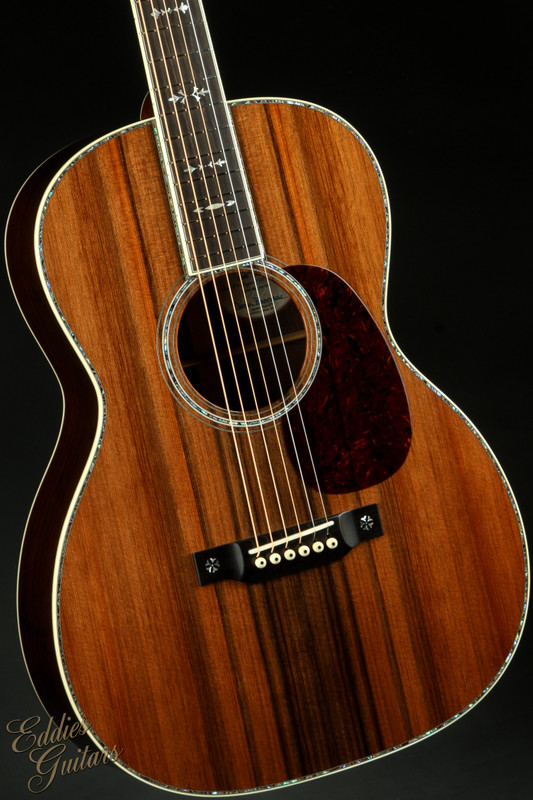
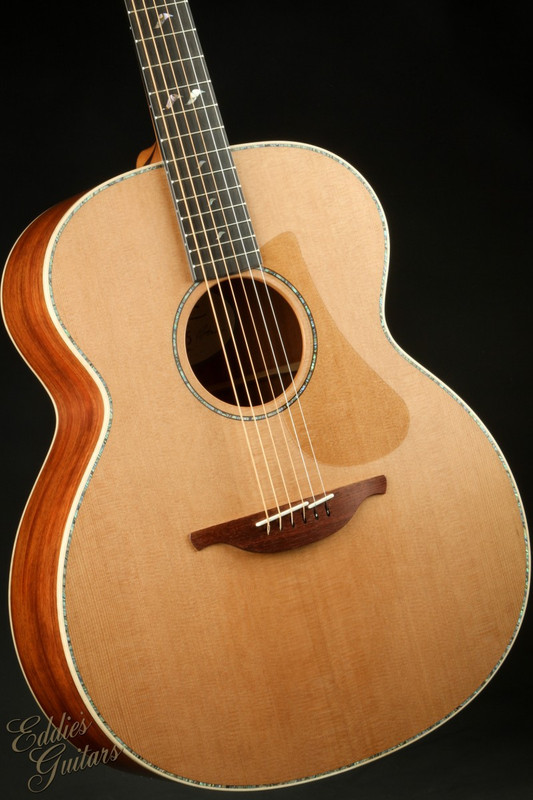
The Judson Riviere Orchestra Model made from Lutz Spruce and Figured Granadillo feels like the kind of instrument born from both quiet study and fearless imagination. At first glance, the guitar carries a serene confidence. The pale Lutz Spruce top glows softly, its tight grain arranged with a sense of poise and readiness, while the back and sides of figured Granadillo shimmer with depth and movement. The wood ripples like flowing water set into stillness, each swirl of dark and amber grain suggesting tonal richness waiting for breath and vibration. Against this warm, complex backdrop, the Indian Rosewood binding frames the body with quiet authority and the multi layer wood and fiber purfling provides the most delicate outline, like a hand drawn border around a sacred manuscript.
The rosette catches the eye next, a custom hybrid design that blends geometry and organic warmth in a way that feels unmistakably handcrafted. It surrounds the soundhole like a thoughtful whisper, a promise that what lies inside is as meaningful as what adorns the surface. A one piece Honduran Mahogany neck rises smoothly from the heel cap of figured maple, meeting a headstock veneered in Brazilian Rosewood that presents the antique gold finished Gotoh 510 tuning machines like jewelry set upon dark stone. The Brazilian Rosewood fingerboard stretches out in quiet elegance, leading to a pinless Brazilian Rosewood bridge shaped with gentle curves that feel grounded and natural. Jescar EVO gold frets rest beneath your fingers with a subtle gleam, while the gold mother of pearl rings with abalone accents offer gentle color at the fretboard’s edge. Each choice of material invites reflection, as though the guitar is not only built but composed.
At the heart of this instrument lies a story of invention. Judson crafted an entirely new bracing system for this guitar, one that refuses to fit neatly into the old vocabulary. It is not X, not falcate, not fan, not ladder, not lattice, not radial. Instead, it borrows from many traditions while belonging fully to none. It is built from Sitka, Lutz, and Engelmann spruce across the top and Sitka spruce for the back, yet the pattern itself grew from experience rather than blueprint. Judson set aside assumptions, set aside the refrain that something should be done because it always has been done, and chose instead to begin from the ground up. He listened to the wood. He studied the frequency response of his past instruments, measured each piece of material, tapped, flexed, and paid attention not to rules but to sensation. Over time, he allowed the tactile voice of the guitar to become its guide. What once felt like a foreign language became a fluent conversation. The more he worked, the less he relied on intuition and the more he trusted what the wood itself was telling him.
This guitar became the culmination of that conversation. Every brace thickness, every angle, every refinement of shape was dictated by ear and hand. No deflection tests, no material property charts, no predetermined goals for frequency response. The instrument asked and Judson answered. The result is a top bracing system that lives on the boundary between science and instinct. It is informed by the past but not bound by it and it carries a sense of intention in every detail.
Judson’s journey to this point began long before. His early years were filled with homebuilt guitar kits and small repair experiments, a teenage fascination with how sound and structure shape one another. He studied at the Guitar Repair and Building Program in Red Wing, Minnesota, where he learned the foundations of acoustic guitar construction. He worked in Lawrence, Kansas, deepening his repair experience at Steve Mason Luthiers and Violin, sharpening his understanding of how instruments live their lives across decades. In 2019, he began a multi year apprenticeship with luthier Jason Kostal, an experience that honed not only his skills but his philosophy. By 2022, he founded Riviere Guitars in Asheville, North Carolina, where he continues to build instruments that embody clarity, responsiveness, and visual grace.
This Orchestra Model reflects that evolution with a clarity that seems almost poetic. The upper bout sound port allows the player to hear the guitar as it breathes, a gentle extension of its voice directed back to the musician. The medium C neck profile welcomes the hand with comfort and familiarity. The 25 inch scale length, the 1 and three quarter inch nut width, the two and five sixteenth inch bridge spacing, and the careful shaping of the bone saddle and scalloped nut all contribute to a sense of balance. At 4 pounds 11 ounces, the instrument feels lively and resonant without sacrificing the physical presence that supports a full and vibrant tone.